
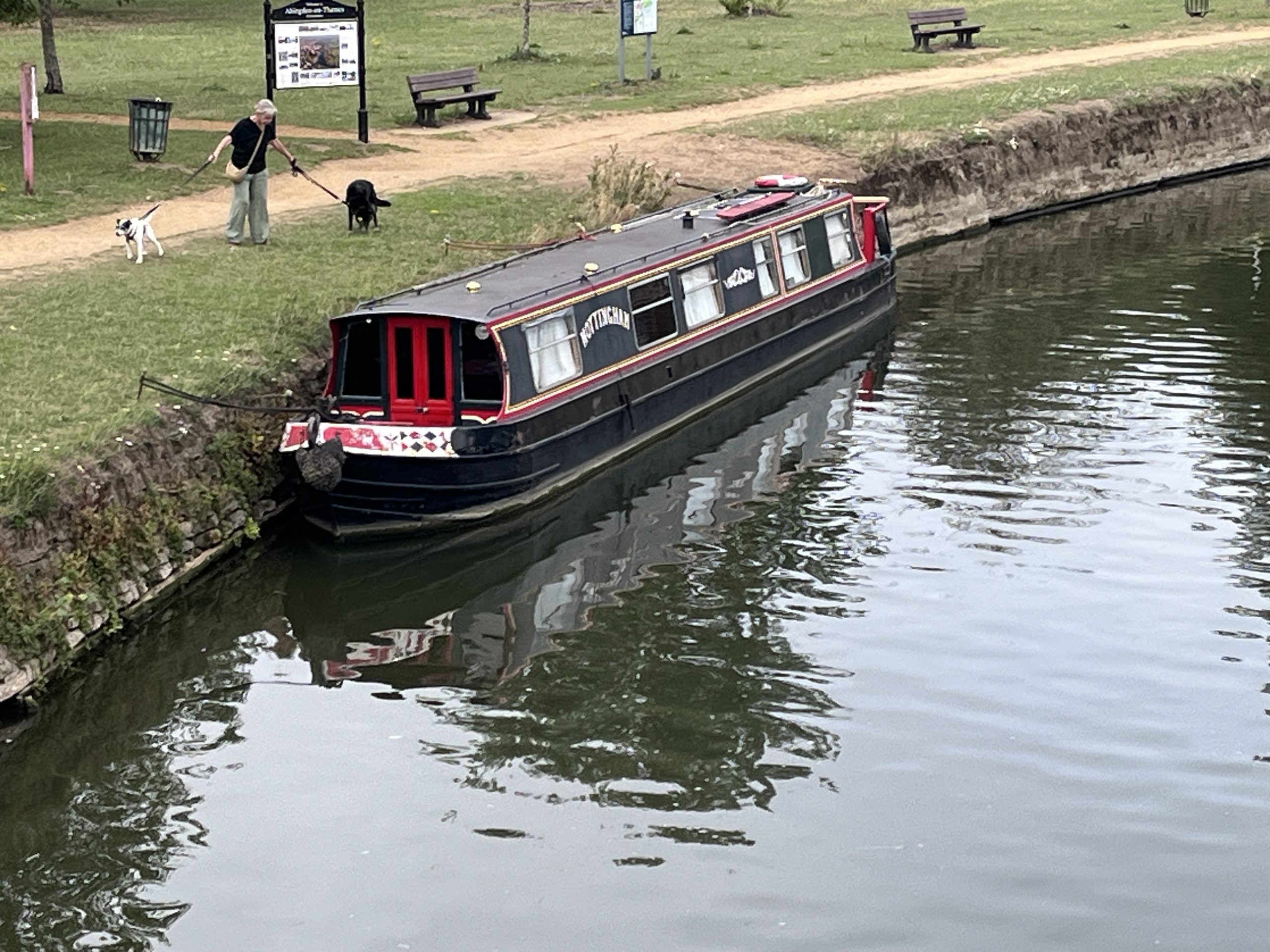
South of Oxford lies Abingdon, a beautiful town that’s very popular with visitors and well worth exploring.
Now that I’m on the Thames, mooring is a completely different experience compared to the canal network. On the canals, you usually have Armco along the banks to tie up to, and you can more or less stop wherever you like (within reason). The river, however, is a different story. Mooring spots are scattered about and not nearly as plentiful. Many boaters “wild moor,” which works fine if you can find a gap without overgrown trees or weeds where it’s safe to tie up—assuming your boat actually fits! You also have to keep an eye on whether the spot is free or chargeable. There are free visitor moorings, but they generally come with a 24-hour limit.
Another big difference is the traffic. With the river’s 8-knot speed limit, boats come past much faster than on the canals, so you really need to stay alert. The upside, though, is the space—at 80 to 100 feet wide, there’s more than enough room to turn around, even do a cheeky U-turn 🤣.
The locks are another bonus. Most of them are electronic and operated by lock keepers during the day, which makes things much easier. Honestly, I wish the canals had the same system!
On this trip, I ended up wild mooring for the night, which was perfect—quiet, peaceful, and nicely tucked away, just how I like it. I was up by 9 a.m. the next morning, but strong winds kept me from setting off right away, so the day turned into a bit of a housework session. Thankfully, the weather calmed by 4 p.m., giving me enough time to get three hours of cruising in before finding a pontoon around 8:30 that evening.
